What Wash Water Filtration Really Does—and Why It Matters
Every vehicle and equipment wash produces a complex wastewater cocktail: suspended grit and fines, emulsified oils and grease, surfactants, metals from brake dust, nutrients, and—seasonally—road salt and brine. Left unmanaged, this runoff can corrode assets, attract regulatory scrutiny, and push operating costs higher. Effective wash water filtration transforms that liability into a controllable, predictable process that supports compliance and reduces total cost of ownership. It begins with capturing runoff on a proper pad or inside a contained bay so no water reaches storm drains without treatment. From there, the goal is to separate what’s easy to remove first—heavy solids and floatables—before polishing the stream to meet site-specific reuse or discharge targets.
Regulatory drivers make this discipline non‑negotiable for fleets, contractors, and municipal operations. The federal Clean Water Act and state-issued NPDES permits prohibit unauthorized discharges to surface waters, while many cities enforce industrial sewer limits for oil and grease, total suspended solids (TSS), pH, and detergents. Wash racks that include containment, oil-water separation, and staged filtration minimize the risk of violations, claims, and unplanned shutdowns. Even more compelling, properly designed systems enable water reclaim—often 50–80%—cutting fresh water spend and reducing the volume of wastewater that must be hauled or discharged.
Performance isn’t just a lab number; it shows up on the balance sheet and in the maintenance bay. Street sweepers, refuse trucks, snow fleets, and yellow iron shed a steady load of sand, fines, and petroleum residues. If these contaminants are not captured at the source, they settle into shop drains, foul pumps, coat warehouse floors, and accelerate rust undercarriages. By moving solids into a sludge trap and skimming free product before it emulsifies, filtration trains keep the whole facility cleaner and safer. Operators in cold-weather regions see an added benefit: removing chloride-rich rinse water helps slow corrosion on frames, brake lines, and electrical connectors, extending service intervals and resale value.
Organizations planning an upgrade can explore system options and best practices for wash water filtration to better understand how each component plays a role—from the slab and sump to media filters and carbon. With the right blueprint, the wash process stops being a compliance headache and becomes an asset that protects the environment, equipment, and budgets.
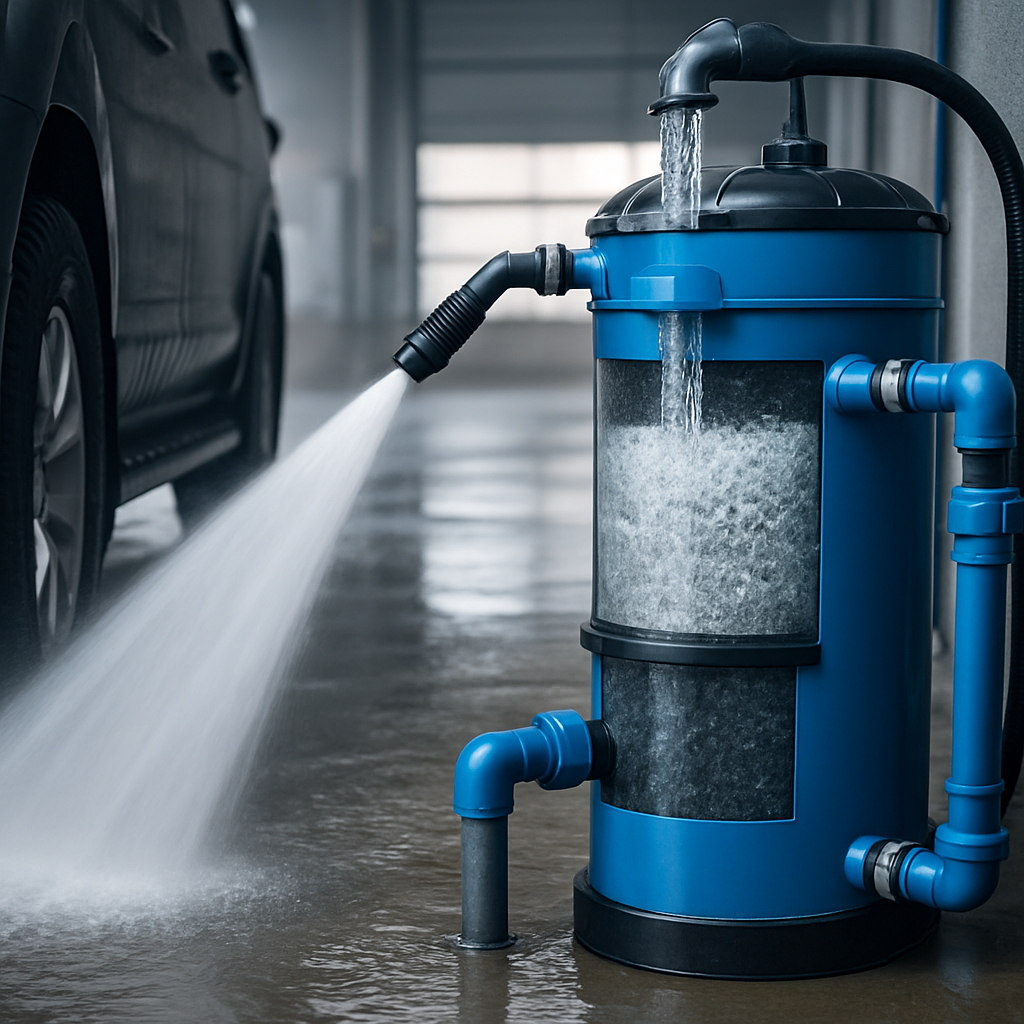
Key Components of a Compliant Filtration Train
A reliable system is more than a single filter; it is a sequence of purpose-built steps that progressively remove contaminants while keeping maintenance manageable. It starts with the surface that gets wet. A sloped, grated pad or portable containment berm channels runoff into a trench drain and sump. This “primary capture” zone lets heavy grit and debris drop out early, conserving downstream filters and avoiding premature pump wear. Many operations include a dedicated sludge pit with easy cleanout access so vacuum trucks can service solids without shutting down the entire line.
From the sump, a duty/standby pump set lifts water to the first stage of treatment. Coarse screens or self-cleaning strainers protect the system from rags, leaves, and large particles. Next, gravity settles additional fines in a clarifier section or cone-bottom tank, sometimes assisted by hydrocyclones when the solids load is high and space is limited. For oily wastewater, a coalescing oil-water separator enhances removal of free and dispersed hydrocarbons; plate packs increase surface area so small droplets merge and rise. Managing oil early keeps later filters from loading with sticky residues that are costly to replace.
Polishing stages target what’s left: smaller suspended solids and dissolved organics. Bag or cartridge filters (50–5 microns) deliver predictable TSS reduction and serve as sacrificial elements ahead of media vessels. Multimedia or sand filters provide higher throughput for fine particles. If detergents or odor are concerns, activated carbon adsorbs surfactants and hydrocarbons, improving clarity and smell—important for reuse loops that feed pressure washers. Where aggressive cleaners or acidic rinse are used, automated pH adjustment with simple dosing pumps keeps discharge or recycle water within safe operating ranges.
For closed-loop reuse, storage tanks with baffles promote additional settling and provide buffer capacity for peak washing hours. Recirculation pumps should be matched to washer demand, and inline monitoring of pH, temperature, and conductivity supports consistent quality. Cold climates benefit from insulated tanks and heat tracing on lines to prevent freeze-ups. Control panels with alarms for high solids, differential pressure across filters, and oil layer thickness keep operators ahead of maintenance tasks. Finally, plan the service path: from basket strainer pull-outs to quick-change bag housings, designing for fast, safe changeovers reduces downtime and labor costs while sustaining compliance targets.
Real-World Scenarios: Fleets, Municipal Yards, and Contractors
Consider a municipal public works yard that services street sweepers, refuse packers, and snow response vehicles. Seasonal grit, leaf litter, and free oil had been overwhelming the floor drains and sending sheen toward a storm inlet after heavy rains. The yard installed a grated wash pad that funnels runoff to a large-volume sump with a dedicated sludge bay. A coalescing separator with easy-access plate packs now removes free hydrocarbons before they can emulsify. Downstream, dual bag filters (25 and 10 microns) followed by a small carbon vessel polish the water for reuse in pressure washers. Within the first year, the site documented a 65% reduction in potable water consumption, avoided sewer surcharges for oil and grease exceedances, and passed a scheduled stormwater audit with no corrective actions.
A construction equipment dealer faced different challenges: clay-rich soils and silica fines that blinded cartridge filters rapidly. The team reconfigured the train to emphasize solids management—adding a cone-bottom clarifier with automatic purge, a hydrocyclone on the recirculation loop, and a polymer dosing system that promotes floc formation during peak loads. With better front-end control, downstream media filters ran cleaner and longer, while undercarriages on loaders and excavators received more consistent rinsing free of abrasive residue. The dealer cut filter replacement costs by nearly half and shortened bay cleanup time because less mud migrated into the shop. That operational stability mattered during quarterly inspections tied to industrial stormwater permits, where records showed consistent TSS reduction and proper sludge handling manifests.
Mobile pressure washing contractors often operate under the tightest constraints. Many municipalities prohibit any wash water from entering storm drains, even when biodegradable soaps are used. One contractor outfitted crews with portable containment mats, vacuum recovery surface tools, and a trailer-mounted filtration skid. On-site, the process routes captured water through a debris strainer, a small settling tank with conical bottom, a compact oil-water separation module, and two-stage bag filters before carbon polishing. The clean effluent is either reused for washing or discharged to a sanitary connection when permitted. Because the system is modular and self-contained, crews can document capture and treatment at each job, meeting local ordinances at distribution centers, transit depots, and retail plazas. This proof of capture and treatment has become a competitive differentiator in bids that reference Clean Water Act responsibilities and local illicit discharge rules.
Regional conditions refine the details. In snowbelt states, chloride-heavy rinse elevates conductivity; operators prioritize quick turnaround through solids separation to keep reused water clear while scheduling periodic partial dumps to manage salt accumulation. In coastal areas where corrosion is relentless, more aggressive rinse cycles and frequent filter swaps protect stainless components and electrical harnesses. Across geographies, the principle holds: when the pad, sump, separator, and filters are sized to the actual contaminant load—and maintained on a realistic schedule—the system pays for itself through avoided fines, reduced water bills, cleaner facilities, and longer-lived equipment.

Thessaloniki neuroscientist now coding VR curricula in Vancouver. Eleni blogs on synaptic plasticity, Canadian mountain etiquette, and productivity with Greek stoic philosophy. She grows hydroponic olives under LED grow lights.