The world of jewellery moves fast, but creating flawless visuals has traditionally been slow, expensive, and inconsistent. Rings, pendants, watches, and bracelets are unforgiving subjects: tiny prongs, mirror-like metals, and gemstone fire reveal every flaw in lighting and retouching. AI jewellery product photography changes the equation, letting brands turn sketches, CAD files, or simple packshots into polished, campaign-ready imagery at scale. With the right workflow, teams can build repeatable styles, launch products faster, and keep creative standards high across e-commerce, social, and print—without the time sink of traditional shoots.
Why AI jewellery product photography is transforming visual production
Jewellery imagery must do three things exceptionally well: capture micro-detail, render materials accurately, and tell a brand story across every channel. Traditional photography can achieve all three, but it’s resource-intensive and hard to scale. Scheduling models, stylists, props, and studio time for every new SKU or seasonal variation quickly becomes a bottleneck. AI-driven production removes those constraints by turning assets you already have—sketches, CAD files, or product photos—into multiple image types with consistent lighting, angles, and finishes. This means the same hero ring can become a white-background packshot, a lifestyle scene on marble, and an on-model macro close-up in a single workflow.
Where jewellery is concerned, precision matters. Gold must look warm without going orange, platinum should be cool without flattening, and diamonds need nuanced dispersion that feels real rather than exaggerated. AI systems trained on high-end categories understand these subtleties. They simulate macro optics, depth of field, and softbox reflections, while preserving tiny engravings and prong geometry. They also help standardise tricky surfaces, from high-polish mirror metals to brushed finishes and pavé settings, so catalogues remain cohesive even when shot at different times or by different teams. For mixed collections—vintage-inspired, modern minimal, gemstone-centric—style templates keep everything visually unified.
The economic upside is just as compelling. Launch cycles accelerate because assets don’t hinge on studio schedules or weather. Variations—yellow vs. white gold, different stone colours, limited editions—no longer require reshoots. Teams can output e-commerce-standard white backgrounds alongside editorial treatments and on-model shots for ads, all from a shared scene library. For growing brands, this efficiency closes the gap between product development and go-to-market, allowing designers to test concepts visually, refine materials, and pitch to retailers using images that already look like the final campaign. The result is a tighter, more agile pipeline where visuals support every step of the product lifecycle.
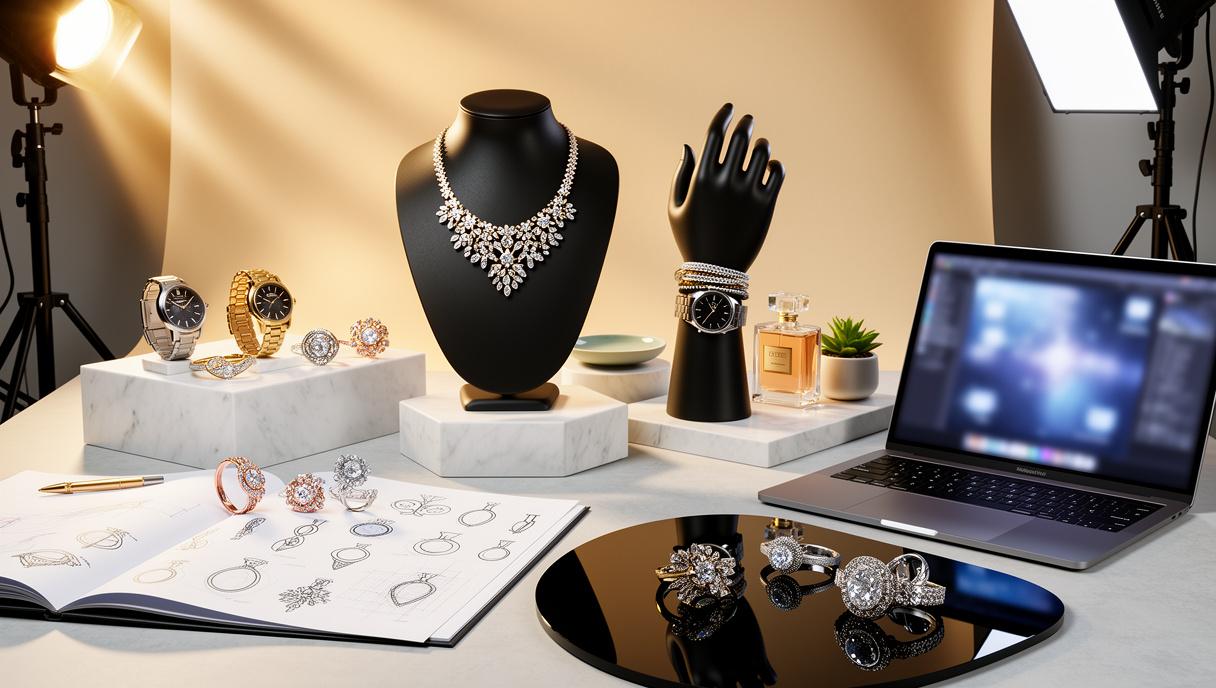
From sketch or CAD to launch-ready assets: an AI-first workflow that scales
An effective AI jewellery product photography pipeline starts with structured inputs and ends with consistent outputs. Designers can upload CAD files, early design sketches, or existing product images. The system maps materials (gold karatage, rhodium-plated silver, rose gold, titanium), stones (diamond, sapphire, moissanite), and surface treatments to photorealistic shaders. Lighting templates emulate common studio setups—a 3-point softbox for reflective metals, polarised light for high-shine gems, diffused windows for lifestyle scenes—so every SKU follows a repeatable look. Macro lens simulation ensures true scale: prongs, facets, and hallmarks read sharply where they should, while depth of field gently falls away in a controlled, believable fashion.
For merchandising, batch generation is where AI truly shines. Angle sets can be defined once—front, 45-degree, side, top, detail crop—and applied across dozens or hundreds of SKUs. Backgrounds can swap from pure white to subtle paper textures or marble slabs, depending on the channel. On the campaign side, creative teams can design room scenes, tabletops, or minimal gradient fields with art-directed colour palettes that match brand guidelines. On-model imagery becomes accessible without large productions, using controls for hand poses, skin tones, and wardrobe styling that support the jewellery as the hero. Outputs in 2K and 4K ensure clarity for both mobile zoom and print trims, while colour profiles keep web and print delivery aligned.
Post-production tools built into the workflow reduce the need for separate retouching passes. Automated dust removal, reflection clean-up, metal edge smoothing, and gemstone fire balancing help maintain realism without drifting into the uncanny. Variant automation handles metal and stone options at scale: a single ring can instantly render in white, yellow, and rose gold, with multiple stone colours or carat weights. Metadata, naming conventions, and alt text can be embedded at export to support DAM systems and e-commerce SEO needs. All of this means brands ship collections faster, with fewer handoffs and less friction. To explore how such a pipeline works in practice, consider platforms built specifically for high-end goods, such as those providing AI jewellery product photography for packshots, lifestyle imagery, and on-model visuals within a unified studio.
Use cases, creative tactics, and quality control for jewellery imagery that sells
Great jewellery photos do more than look pretty—they influence conversion, returns, and customer confidence. On product detail pages, consistent angles, accurate scale references, and detailed macro crops reduce uncertainty. The hero image should be clean and high-contrast, while secondary shots can demonstrate clasp function, chain drape, setting height, and profile views that shoppers can’t infer from a single angle. For marketplaces and paid channels, adhere to platform requirements (file size, format, background, coverage) while maintaining brand signature through subtle lighting style, reflection control, and a distinct yet compliant background tone. AI scene templates help keep this consistency no matter which collection is launching next week.
On social and in campaigns, editorial treatments carry the brand story. Lifestyle vignettes—soft linen, travertine, deep velvet—evoke seasonality and occasion. On-model close-ups show scale on the ear, wrist, or hand, solving a common e-commerce pain point. With AI-driven production, teams can test multiple art directions quickly: morning window light vs. glossy studio reflections, warm vs. cool palettes, minimal vs. rich prop styling. When a direction proves to outperform, it becomes a reusable scene blueprint for future drops. For localised campaigns—say, a Valentine’s push in the UK or a summer capsule in the Gulf—subtle shifts in colour temperature, backgrounds, and wardrobe cues adapt the same hero product to distinct markets without spinning up separate physical shoots.
Quality control underpins everything. Calibrate monitors and use consistent colour-management settings across teams. Define reference swatches for metals and gem tones so the AI maps materials to brand-approved values every time. Pay attention to gemstone realism: dispersion should be present but not flashy; facet edges must remain sharp; inclusions should be consistent with the product tier. For metals, watch for over-smoothing or plasticity and keep micro-reflections believable, with light gradients that feel physically grounded. Verify scale by comparing ring diameters or chain lengths against proper measurements, and avoid perspective exaggerations that make studs look larger than life on product pages. Finally, inspect exports at 2K and 4K to ensure there’s no aliasing on prongs or halos around fine chains.
Consider a common real-world scenario. A boutique jeweller prepares a 120-SKU launch comprising signet rings, huggie hoops, and delicate chain necklaces in three metal variants. With a traditional production model, the team would need multiple shoot days, retouching rounds, and a follow-up session to capture missed angles. With an AI-first pipeline, they import CAD for pieces still in prototyping and existing product photos for final samples. They apply a pre-approved packshot template (45-degree hero, left/right sides, top, macro clasp), generate all metal and stone variants, and output web-ready sRGB images and print-ready high-res files in one pass. Simultaneously, they test three lifestyle directions—marble and daylight, velvet and softbox, linen and warm window—picking the strongest performer for ads. The entire catalogue is ready in days rather than weeks, and, most importantly, looks like one cohesive brand rather than a patchwork of separate shoots.
As the jewellery category continues to move online, the winners will be those who treat imagery as a system: repeatable, measurable, and creatively expressive. AI jewellery product photography provides the discipline for standardisation and the freedom for art direction, enabling designers, artisans, and luxury marketers to move at the speed of their ideas without compromising on craft.

Thessaloniki neuroscientist now coding VR curricula in Vancouver. Eleni blogs on synaptic plasticity, Canadian mountain etiquette, and productivity with Greek stoic philosophy. She grows hydroponic olives under LED grow lights.