Why Bedford Is Perfect for Solar PV
Bedford enjoys a compelling mix of strong solar potential, rising energy costs, and supportive UK incentives—an ideal setting for solar panels to shine. Across Bedford and the wider Bedfordshire area, most rooftops have unobstructed south, east, or west aspects, which makes it straightforward to capture the region’s reliable daylight hours. Modern solar PV systems also perform impressively on bright, overcast days, so households and businesses are no longer limited to peak summer conditions to see real benefits.
Well-sited arrays in Bedford typically generate around 850–1,050 kWh per installed kWp each year, depending on roof orientation, tilt, and any shading from chimneys or nearby trees. That means a 4 kWp system on a typical semi-detached home can deliver thousands of kilowatt-hours annually—power that offsets grid use and offers long-term price stability. For businesses with longer daytime operating hours, rooftop solar can directly reduce operating costs during trading hours and improve sustainability credentials at the same time.
Incentives further strengthen the case. The UK’s Smart Export Guarantee (SEG) pays for surplus electricity exported back to the grid, turning sunny days into a revenue stream. For homes, there is currently a zero VAT rate on qualifying energy-saving installations, including solar panels and, more recently, some types of battery storage—helping reduce upfront costs. Planning rules are generally friendly too: most domestic systems are “permitted development,” provided they don’t protrude above the roof ridge or by more than 200mm and aren’t on listed buildings or certain conservation area frontages. Local checks are still essential, but many Bedford properties sail through without formal planning requirements.
Bedford’s housing stock—from Victorian terraces to modern estates—supports a range of mounting solutions. Pitched roofs suit in-roof or on-roof systems; flat roofs on extensions and commercial buildings can use ballasted racking that avoids roof penetrations. Ground-mounts are an option for properties with land. Because solar PV integrates seamlessly with other technologies—like battery storage, EV charging, and hot water diverters—Bedford residents can turn rooftops into smart, flexible energy hubs that cut bills, raise EPC ratings, and reduce carbon footprint year after year. For local homeowners and businesses exploring options for Solar Panels in Bedford, the pathway to cleaner, more affordable power is clearer than ever.
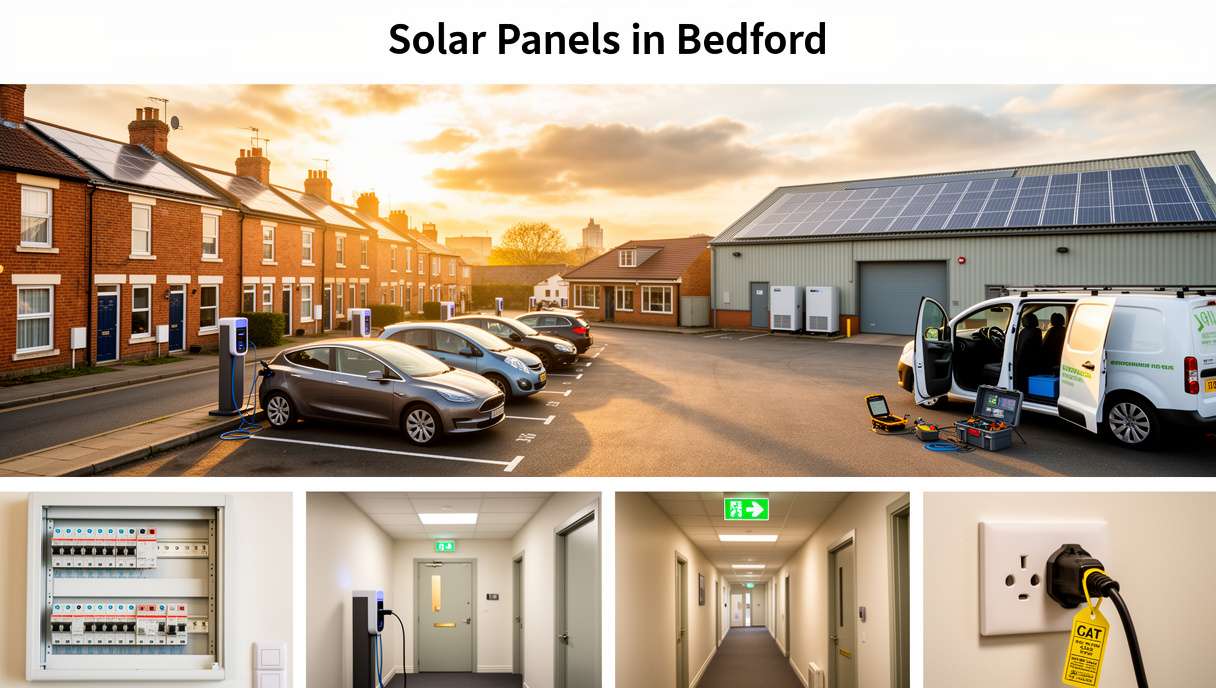
What a Professional Bedford Solar Installation Looks Like
A quality installation in Bedford starts with a thorough site survey and tailored system design. Technicians assess roof condition, orientation, pitch, and shading to map out panel placement and string design. Advanced modeling tools estimate monthly and annual yield, while detailed shade analysis helps determine whether standard string inverters, power optimisers, or microinverters are the best fit. This is especially valuable in Bedford’s mixed streetscapes, where chimneys and dormers can add patchy shade across the day.
Following design, the installer confirms distribution network operator (DNO) requirements. Most domestic systems up to 3.68 kW per phase fall under G98—installed and then notified—while larger arrays typically need G99 pre-approval. Professional installers manage these steps, along with any necessary scaffolding, to ensure safe roof access and code-compliant workmanship. On installation day, mounting rails are fixed to structurally sound rafters, panels are secured, and DC cabling is neatly contained to protect against weathering. Indoors, the inverter and ancillary equipment—AC isolators, generation meters, surge protection, and monitoring gateways—are positioned for accessibility and adequate ventilation.
Integration with the property’s electrical system is handled by qualified electricians who ensure compatibility with the existing consumer unit and protective devices such as RCDs/RCBOs. They’ll commission the system, verify it meets current standards, and connect monitoring so you can track real-time production and self-consumption. After commissioning, you should receive a comprehensive handover pack: MCS certificate (often required for SEG export payments), electrical installation certification, product warranties, and user guidance for the monitoring app and shutdown procedures.
Warranties and maintenance matter as much as installation quality. Most tier-one panels carry 25-year performance warranties and 10–15-year product warranties. Inverters frequently offer 5–12 years, with options to extend. Professional maintenance is minimal—visual checks, occasional cleaning if debris builds up, and firmware updates for the monitoring platform—but it pays to schedule periodic inspections to catch wear-and-tear early, especially on commercial roofs exposed to harsher conditions. A clean, well-maintained system consistently delivers higher yields and extends asset life.
For Bedford’s diverse properties—from compact terraces and bungalows to warehouses and school buildings—a professional solar partner will also consider fire safety clearances, cable routes that respect historic features, and future-proofing for add-ons such as battery storage or EV chargers. That integrated, standards-led approach ensures your solar panels work safely, efficiently, and seamlessly with the rest of your electrical infrastructure.
Getting the Most from Solar: Batteries, EVs and Smart Tariffs in Bedford
Maximising the benefits of solar panels in Bedford often comes down to smart energy management—using more of your own generation when and where it matters. Battery storage is the most effective way to lift self-consumption. A right-sized battery (commonly 5–10 kWh for homes) captures daytime surplus and releases it in the evening, smoothing peaks and covering overnight baseloads like refrigeration and networking gear. For properties with occasional outages, systems with emergency power supply (EPS) can support critical circuits during a grid cut, offering a measure of resilience as well as savings.
The choice between AC-coupled and hybrid (DC-coupled) batteries depends on the property and goals. Hybrid inverters pair panels and batteries through a single unit for higher round-trip efficiency, while AC-coupled batteries can retrofit to existing PV or operate independently. Either way, automated charge/discharge schedules are essential. With time-of-use tariffs becoming more popular in Bedfordshire, batteries can charge from the grid during cheap off-peak windows and discharge when rates rise—an approach that complements solar generation and can accelerate payback. Export tariffs under the SEG reward surplus too, so the optimal strategy balances bill reduction with export revenue.
EV charging adds another layer of opportunity. Solar-aware chargers can prioritise excess PV for car charging, making the most of sunny days. If you work from home or have flexible charging schedules, daytime solar can meaningfully offset transport costs. For families returning after school or work, a battery can bridge the gap, delivering solar energy to the car later in the evening. Hot water diverters are a popular add-on as well, routing surplus PV into an immersion heater to pre-heat cylinders, further lifting self-consumption without complex controls.
Consider two Bedford scenarios. A three-bedroom semi installs a 4 kWp array with a 7 kWh battery. With sensible appliance timing—running the washing machine and dishwasher during midday and using smart battery scheduling—annual self-consumption can climb dramatically, reducing reliance on the grid in both summer and shoulder seasons. For a small local warehouse with a 30–50 kWp array, peak generation aligns with operational hours, slashing imported energy and dampening the effect of price spikes. Adding batteries helps shave late-afternoon demand, while exporting surplus on quiet days taps into SEG income. Both cases benefit from real-time monitoring: by reviewing daily load profiles, it’s easy to adjust setpoints, schedule EV charging, and track performance against expectations.
Because every building, roof, and routine is unique, the best results come from a holistic plan that ties together solar PV, battery storage, load-shifting, and tariffs. That plan should include future flexibility—space for extra panels, battery expansion, or a second EV charger—plus clear safety and compliance checkpoints. Bedord residents and businesses who take this integrated approach consistently see stronger returns, steadier bills, and measurable carbon cuts from their solar panels. The path forward is practical and proven: design for your roof and routine, install to current standards, and let smart controls do the heavy lifting.

Thessaloniki neuroscientist now coding VR curricula in Vancouver. Eleni blogs on synaptic plasticity, Canadian mountain etiquette, and productivity with Greek stoic philosophy. She grows hydroponic olives under LED grow lights.