Military experience builds problem-solvers who thrive under pressure, communicate clearly, and follow rigorous procedures—precisely the qualities employers seek in heating, ventilation, and air conditioning roles. As homes and businesses modernize, the HVAC field is reshaping comfort, energy efficiency, and indoor air quality. For service members moving into civilian life, targeted HVAC training turns operational discipline into a stable, high-demand career. Whether you’re interested in diagnostics, quality installation, or advancing into leadership, veteran-focused HVAC programs translate real-world mission skills into technical know-how for heat pumps, furnaces, refrigeration, airflow, smart controls, and more.
Why HVAC Is a Smart Civilian Career for Veterans
The HVAC industry blends hands-on work with critical thinking, which makes it a natural fit for veterans who excel in structured, results-driven environments. Day to day, technicians troubleshoot systems, interpret readings, and apply safety protocols—tasks that reward the same attention to detail and teamwork cultivated in the service. The market outlook is equally compelling: as electrification and decarbonization accelerate, demand for technicians skilled in heat pump systems, advanced controls, and indoor air quality continues to rise. Homes are switching from aging equipment to high-efficiency solutions, while commercial buildings upgrade ventilation and commissioning standards. That growth translates into consistent service calls, installation projects, and long-term career stability.
Another advantage is the clear progression built into HVAC work. With focused HVAC training, you can enter the field as an installer or service apprentice and develop into a senior technician, controls specialist, or field supervisor. Many veterans quickly move into roles that leverage leadership, logistics, and quality assurance—managing crews, optimizing job sequencing, and documenting performance outcomes. For those who prefer strategic responsibilities, commissioning, system design verification, and energy auditing offer rewarding paths that reward both analytical and communication skills.
Technically, the field is evolving in ways that reward continuous learners. Heat pump adoption is surging in both hot and cold climates, requiring solid grounding in refrigerant circuits, airflow diagnostics, and proper charging practices. Safety remains paramount as the industry transitions to new A2L refrigerants with lower global warming potential, bringing updated handling procedures and code compliance into daily practice. Beyond mechanical systems, connected thermostats, zoning, and building automation systems open doors for veterans skilled in electronics and systems thinking. When combined with strong customer communication, that breadth of capability becomes a competitive edge—especially for those who enjoy mentoring others, teaching best practices, or leading teams through challenging installs.
Most importantly, HVAC offers something veterans value: meaningful work with immediate results. Whether restoring heat during a winter emergency or commissioning an efficient system that lowers bills for a community center, the mission is tangible. Your service mindset—respond swiftly, fix it right, verify performance—directly translates to delivering safe, reliable comfort for families and businesses.
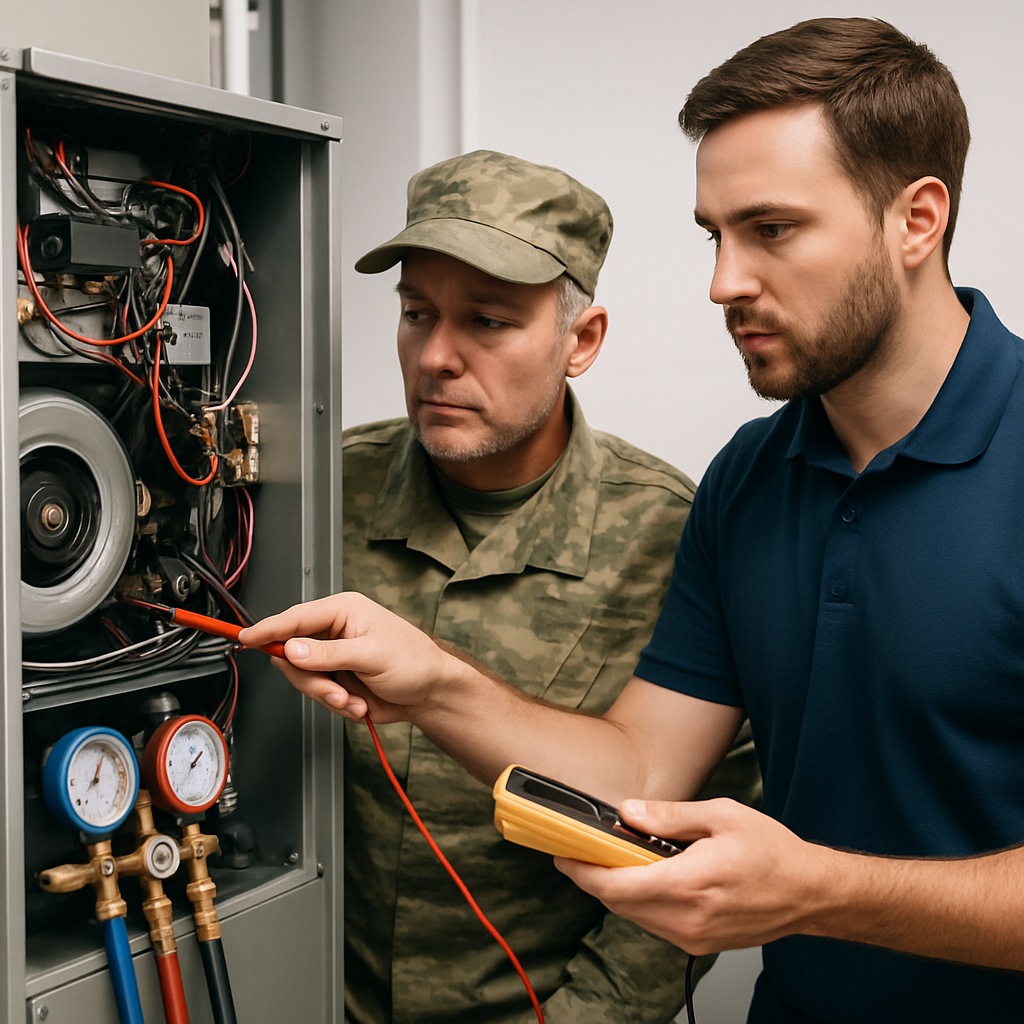
What Quality HVAC Training for Veterans Should Include
Not all training is created equal. The best programs for veterans focus on real equipment, measurable outcomes, and the practical skills needed to succeed on day one. Hands-on labs should mirror service calls and installations you’ll encounter in the field: diagnosing no-cool conditions, resolving low airflow caused by high static pressure, commissioning new heat pumps, and verifying refrigerant charge. Expect a strong emphasis on airflow and duct design, load calculations, and system setup—because even a perfect unit underperforms if ducts are undersized or return paths are restricted.
Your core curriculum should cover electrical fundamentals, combustion safety, refrigerant recovery and charging, controls and thermostats, and the latest heat pump configurations. Training that incorporates zoning, ventilation, and indoor air quality prepares you for whole-home solutions rather than quick fixes. Safety modules must be non-negotiable: proper PPE, lockout/tagout, working around high voltage, and the safe handling of A2L refrigerants. Strong programs also help you prepare for third-party validations such as EPA Section 608, NATE-ready knowledge, and OSHA-10 awareness—credentials that boost employability and confidence.
Great training centers meet you where you are. That can include accelerated boot camps, evening or weekend cohorts, and blended learning with online modules that complement lab time. Programs that value your service background often provide structured pathways for those new to HVAC as well as advanced tracks for experienced technicians. Ask providers about credit for prior learning, tutoring support for technical math or electrical schematics, and small-group instruction that ensures you get time on the tools. If you plan to use VA benefits, confirm eligibility and documentation requirements early; many veteran-friendly schools will walk you through the process and timelines.
Finally, look for programs rooted in quality installation and measurable performance outcomes. That means instructors who expect you to verify charge with subcooling and superheat, measure and correct static pressure, commission with manufacturer setup procedures, and document results. Courses that simulate call-backs and real-world constraints—tight schedules, limited access, and homeowner expectations—build the decision-making skills employers crave. If you value this approach, explore specialized HVAC training for veterans that blends hands-on labs with system design, airflow, zoning, refrigerant charging, and furnace fundamentals to prepare you for the most common (and most costly) field challenges.
Transition Strategies, Local Opportunities, and Real-World Scenarios
Successful transitions follow a playbook. Start by translating your military experience into civilian language: preventive maintenance becomes planned service; troubleshooting becomes diagnostics; leading a squad becomes supervising an install crew. Highlight safety mindset, chain-of-custody diligence, inventory control, and documentation—employers know these drive fewer call-backs and higher customer satisfaction. Build a resume that lists tools you’ve used (manifolds, digital gauges, micrometers, manometers), procedures you know (nitrogen pressure testing, evacuation and dehydration, combustion analysis), and outcomes you’ve delivered (first-time fix rates, energy savings, improved IAQ).
Next, align your training and certifications with local demand. In colder climates, deep knowledge of cold-climate heat pumps, defrost strategies, and auxiliary heat integration will differentiate you. In hotter regions, mastering airflow balancing and refrigerant management for long-line sets matters. Urban markets may prioritize ventilation, filtration, and building automation; rural areas often seek generalists who can handle residential and light commercial. Check utility incentives and state programs that reward commissioning, duct sealing, or electrification—technicians who can document results often command premium wages and have priority with energy-efficiency contractors.
On-the-job scenarios underscore the value of comprehensive training. Consider a no-cool call where a rooftop unit is short-cycling. A superficial approach might blame a low charge, but veteran technicians verify airflow first: measure external static pressure, check filter and coil cleanliness, confirm blower tap settings, and ensure correct duct sizing. Only after airflow is in spec should you validate charge using subcooling targets. In another case, a heat pump repeatedly trips breakers during defrost; disciplined troubleshooting isolates a failed outdoor fan motor and a control board configuration error, both corrected with manufacturer procedures and functional testing. These are the types of decisions strengthened by a foundation in airflow diagnostics, electrical systems, and commissioning.
Veterans also excel in leadership tracks. After a year or two in the field, many move into lead installer or service team lead roles, where they plan job logistics, mentor apprentices, and own quality control. Some pursue system design or sales engineering, using technical credibility to craft right-sized solutions based on Manual J/S/D calculations and building performance data. Others turn to training, helping new hires master furnaces, zoning, and refrigerant charging. Imagine a former avionics technician guiding a crew through a multi-zone heat pump retrofit: duct modifications documented, static pressure reduced with proper returns, charge verified, and homeowner trained on smart thermostat schedules. That’s the blend of precision and communication hiring managers love to see.
Wherever you land—residential service, light commercial, facility maintenance, or energy programs—your mission-first mindset will set the tone for reliable, safe, and efficient outcomes. By selecting veteran-focused HVAC training that emphasizes hands-on labs, measurable commissioning, and current refrigerant and code practices, you’ll step into a high-demand trade with the confidence to solve problems, lead teams, and build a career that keeps communities comfortable year-round.

Thessaloniki neuroscientist now coding VR curricula in Vancouver. Eleni blogs on synaptic plasticity, Canadian mountain etiquette, and productivity with Greek stoic philosophy. She grows hydroponic olives under LED grow lights.