
Reliable heating and instant hot water are non‑negotiable in modern apartments and mixed‑use buildings. For properties on district or communal networks, that comfort hinges on a well-maintained Heat Interface Unit. A thorough, scheduled HIU service optimises performance, prevents breakdowns, controls energy costs and extends asset life—vital outcomes for homeowners, landlords and property managers alike across London.
What an HIU Service Involves and Why It Matters
A Heat Interface Unit (HIU) acts as the bridge between a building’s primary network and the individual dwelling. It transfers heat through a plate heat exchanger to deliver space heating and domestic hot water without storing large volumes of water in each flat. Over time, components like strainers, mixing valves, actuators and temperature sensors can foul, drift out of calibration or simply wear. A professional HIU service addresses this gradual decline before it becomes a disruptive failure.
The service typically begins with diagnostics and performance benchmarking: logging primary and secondary temperatures, ∆T across the exchanger, pressure readings and flow rates. Engineers then inspect and clean strainers and filters that trap magnetite and debris—common culprits behind low flow, noisy operation and cold radiators. They also check the plate heat exchanger for scaling, verify the domestic hot water (DHW) preheat strategy, and calibrate or replace the thermostatic mixing valve to stabilise outlet temperatures safely. Control valves, including PICVs and differential pressure valves, are tested to ensure accurate modulation and quiet operation under load.
These tasks are not just about comfort. When an HIU runs efficiently, it supports lower primary return temperatures and better ∆T on the network, which improves plantroom efficiency and reduces pump energy. That system‑wide benefit is particularly relevant on London’s dense heat networks, where hundreds of units interact. Routine servicing helps prevent emergency callouts, reduces complaints, and extends equipment life—especially important for landlords managing portfolios and for residents who rely on stable hot water at peak times. Whether the HIU is from a leading brand or a legacy model, a structured maintenance plan keeps it compliant, quiet and efficient throughout the year.
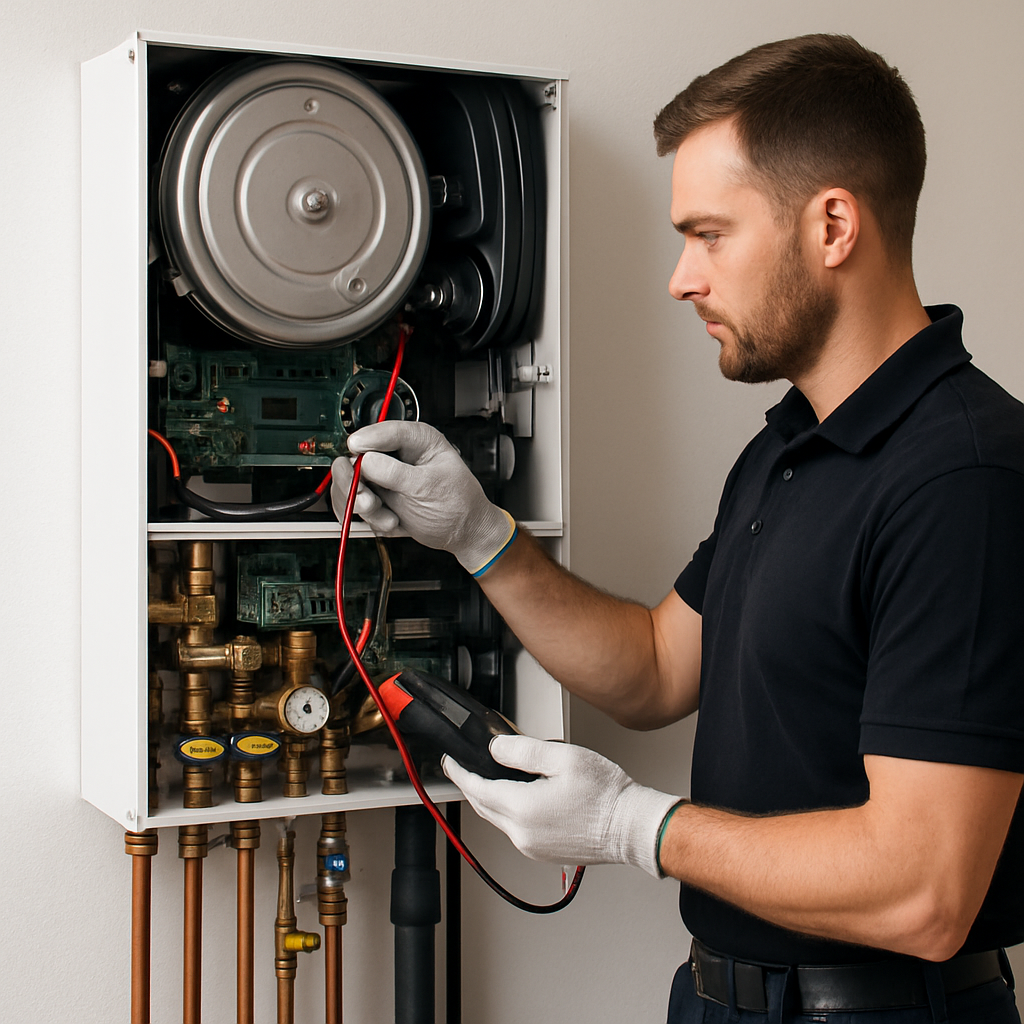
Inside a Professional HIU Service: Tasks, Testing and Optimisation
A comprehensive HIU service covers both preventative maintenance and fine‑tuning. After initial checks, engineers isolate and clean strainers, flush debris, and assess the plate heat exchanger for fouling or limescale. If performance is compromised by scaling, targeted descaling restores heat transfer efficiency and reduces lag to hot water taps. Actuators and cartridges are inspected for smooth travel; sticking parts cause temperature swings, poor DHW prioritisation, and unnecessary wear on pumps. Thermostatic mixing valves are recalibrated to maintain safe and consistent outlet temperatures, and any failed sensors or fuses are replaced. Where fitted, heat meters are assessed for error codes and correct reading, supporting fair billing and system analytics.
Beyond the core service, engineers evaluate dynamic operation: DHW response time, preheat settings, and space heating recovery under realistic load. They verify correct operation of PICVs and differential pressure control to prevent water hammer and whistling. Controls are updated to the property’s usage pattern—vital for student blocks, build‑to‑rent schemes and family homes with different peak demands. If radiators or underfloor loops are underperforming, the HIU check may uncover circulation issues upstream; a recommendation for targeted powerflushing can then restore design flow rates. For those planning ahead, an annual booking for HIU Service helps maintain warranty compliance and streamlines estate‑wide maintenance calendars with fixed, predictable costs.
Documentation is as important as the spanners. A good service record includes before‑and‑after readings, parts replaced, and advisories on future work—such as replacing a heavily scaled plate, upgrading a failing actuator, or improving insulation on exposed pipework. This evidence supports landlord responsibilities, simplifies audits for property managers, and provides clarity for residents who want to understand the cause of previous issues. When repeated annually, these records build a performance history that helps anticipate failures, budget intelligently, and keep primary return temperatures within target—key to cutting network energy consumption and operating costs.
Real‑World Scenarios in London: Faults, Fixes and Performance Wins
London’s building stock presents varied challenges, from heritage mansion blocks to new‑build towers. A common scenario is intermittent hot water: taps run warm then cold, or take too long to heat. During servicing, engineers often find partially blocked strainers, scaled plates or mis‑set preheat functions. By cleaning filters, descaling the exchanger, and recalibrating DHW prioritisation, hot water response becomes immediate and stable—reducing resident complaints and water waste. Another frequent issue is noisy operation caused by excessive differential pressure or incorrectly set PICVs; a proper HIU service restores quiet, efficient modulation and prevents wear on valves.
In mixed‑use developments, morning spikes can overwhelm poorly tuned units, leading to cold radiators just when residents need heat most. Engineers address this by verifying flow rates, balancing secondary circuits, and aligning control strategies with occupancy patterns. Even small adjustments—like setting appropriate minimum flows, correcting temperature probes, or replacing a drifting mixing valve—can dramatically improve comfort. Where underheating persists, a broader system review may point to circulation bottlenecks; recommending powerflushing of affected branches or introducing better dirt separation can unlock design performance without disruptive replacements.
For landlords and property managers, coordination is often as critical as the technical fix. Portfolio‑wide annual servicing with fixed pricing makes budgeting cleaner and reduces reactive callouts. Access windows are scheduled to minimise disruption, while comprehensive reports document legal and operational readiness. Residents benefit from fewer breakdowns and predictable hot water temperatures, and the network benefits from healthier ∆T, which lowers primary return temperatures and reduces distribution heat losses. Across inner and outer London, these gains translate to tangible outcomes: quieter systems, quicker hot water at the tap, fewer out‑of‑hours emergencies, and longer lifespans for costly components. By treating HIU service as planned preventative maintenance rather than a last‑minute rescue, buildings stay comfortable, efficient and ready for the heaviest winter demand.

Thessaloniki neuroscientist now coding VR curricula in Vancouver. Eleni blogs on synaptic plasticity, Canadian mountain etiquette, and productivity with Greek stoic philosophy. She grows hydroponic olives under LED grow lights.
